
Blooming
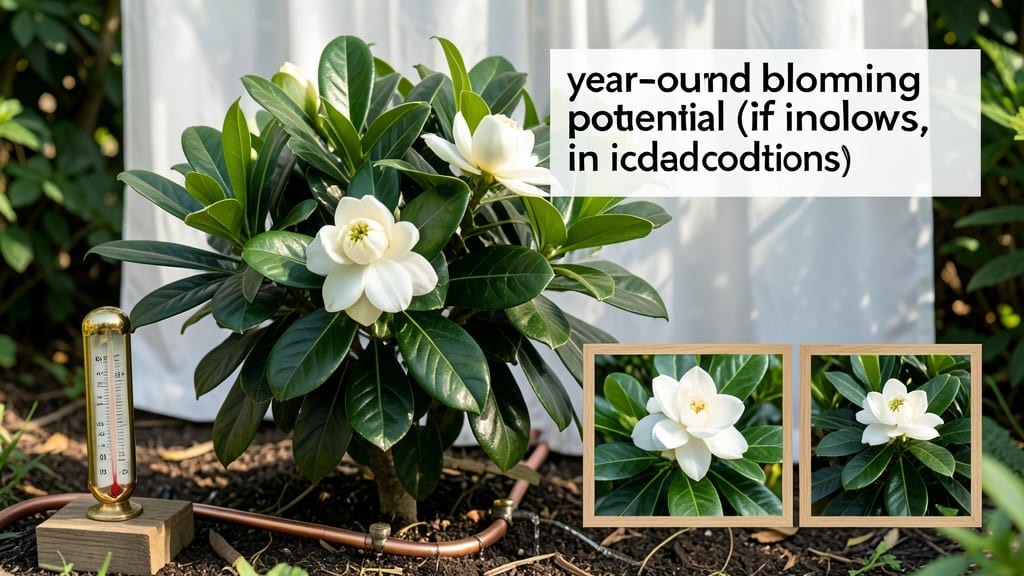
Gardenias don't bloom all year naturally, as their flowering cycles are tightly linked to seasonal cues like temperature shifts and daylight changes. While they might produce occasional blooms in warm climates, their most abundant flowering happens during spring and summer months.
Gardenias are sensitive to daylight hours—a phenomenon called photoperiodism—which triggers their blooming cycles. 🌸 In tropical regions, they may show sporadic blooms year-round, but true continuous flowering is rare even in ideal conditions.
The key to extending their bloom periods lies in mimicking natural seasonal changes through proper care, like strategic pruning and nutrient adjustments that support their flowering mechanisms.
For gardeners in cooler climates, understanding these patterns is crucial. Gardenias often enter dormancy during winter months, conserving energy until spring's longer daylight and warmer temperatures signal it's time to bloom again.
Even in warm areas, you'll notice peak flowering seasons rather than constant blooms, as the plants follow their biological rhythms.
💡 In This Article
- Seasonal and Climate Factors Affecting Gardenia Blooms
- Tips to Prolong Gardenia Blooms Beyond Natural Seasons
Seasonal and climate factors affecting gardenia blooms
Gardenias are highly responsive to daylight length—a process called photoperiodism—where shorter winter days trigger dormancy while longer spring/summer days stimulate blooming.
In tropical zones (like Florida or Hawaii), gardenias may produce 3-4 bloom cycles per year due to minimal seasonal temperature swings, but even here, blooms cluster during spring (March-May) and fall (September-November) when humidity peaks and nights stay warm. 🌿 The plant's internal clock measures daylight through phytochrome pigments, which activate flowering hormones when light exposure exceeds 12 hours daily.
Temperature plays an equally critical role. Gardenias thrive in 65-75°F daytime temperatures but need cooler 55-65°F nights to set buds properly. Below 50°F, buds often drop off, while above 85°F, flowers may open too quickly and fall prematurely.
In temperate climates (Zones 7-10), gardenias typically enter 6-8 week dormancy periods during winter, conserving energy until spring's warming temperatures and increasing daylight trigger new growth and blooms.
Humidity levels also create dramatic differences. Gardenias originate from Southeast Asia's high-humidity environments, where 60-80% humidity supports their delicate blooms. In arid climates, you'll notice fewer blooms and smaller flowers as the plants divert energy to drought resistance.
The combination of these factors explains why gardenias in coastal Southern California may bloom sporadically year-round (thanks to mild winters and ocean breezes), while those in central Texas produce concentrated spring blooms followed by summer dormancy.
Regional climate variations create fascinating bloom patterns. For example, gardenias in Hawaii's tropical climate may produce continuous but lighter blooming throughout the year, while those in Georgia's humid subtropical zone show two distinct peak seasons with heavier blooms.
The key difference lies in temperature consistency—tropical regions maintain optimal ranges year-round, while temperate zones experience monthly temperature fluctuations that reset the plant's biological clock.
What most gardeners don't realize is that gardenias actually prefer temperature contrasts between day and night to produce their best blooms. A 10-15°F difference between daytime highs and nighttime lows signals the plant to invest energy in flower production rather than foliage growth.
This explains why gardenias in coastal Florida (with minimal temperature swings) produce larger but fewer blooms compared to those in North Carolina's Piedmont region, where the spring temperature shifts trigger more abundant but slightly smaller flowers.
Even in ideal climates, gardenias follow a budding-to-bloom cycle that takes 4-6 weeks from bud formation to full bloom. This biological timing means you'll never see continuous flowering—there's always a 2-4 week gap between bloom cycles as the plant resets.
Understanding this natural rhythm helps explain why gardeners in Southern California might see blooms in January, May, and September rather than year-round coverage.