
Tools
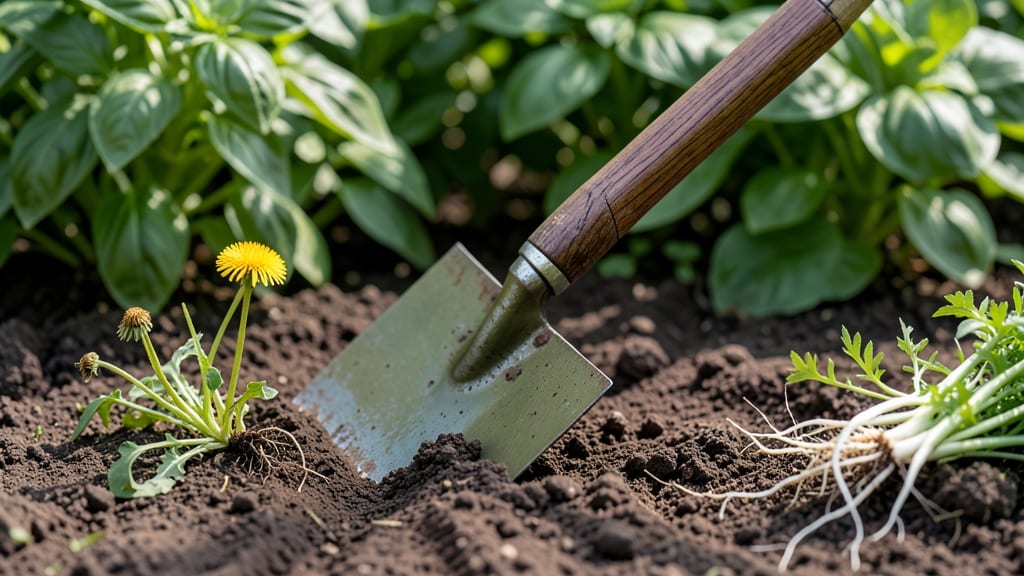
A garden hoe is used for breaking up soil, removing weeds, leveling garden beds, and creating furrows for planting. Its versatile blade helps cultivate, aerate, and maintain healthy garden spaces efficiently.
A garden hoe transforms your gardening experience by making soil work easier and more effective. 🌱 Whether you're prepping a new bed or maintaining existing plants, its sharp blade cuts through compacted earth while pulling weeds from the roots—something rakes can't do.
I've found that using a hoe regularly keeps my garden beds looking neat and prevents weeds from taking over before they become a problem.
The right technique makes all the difference—holding the blade at a 45-degree angle lets you slice through weeds without disturbing nearby plants. For hard-packed soil, a draw hoe works best to chop up clumps, while a stirrup hoe gives you more control for precision tasks.
Pairing your hoe with a broadfork for deeper soil aeration creates the perfect combo for healthy roots and better water drainage.
💡 In This Article
- Key Functions of a Garden Hoe in Soil Cultivation
- Best Practices for Using a Hoe in Weed and Soil Management
Key functions of a garden hoe in soil cultivation
A garden hoe's primary function is soil cultivation, where its blade acts like a precision scalpel for the earth. The draw hoe with its long, straight blade works by slicing through compacted soil when pulled toward you, breaking up clumps into finer particles.
This process improves soil aeration by creating tiny air pockets—critical for root respiration—while also exposing buried weed seeds to sunlight, which halts their germination. The mechanical action mimics the natural tillage done by earthworms but on a larger scale.
The stirrup hoe, with its offset blade, offers more control for weeding between rows. Its design allows you to push the blade into the soil at a 45-degree angle, then lift it with a twisting motion to extract weeds by their roots without disturbing nearby plants.
This precision is especially useful in vegetable gardens where spacing matters. Meanwhile, the warren hoe combines features of both types—its short handle and wide blade make it ideal for chopping weeds in tight spaces or creating furrows for seeds.
What makes these tools so effective is their ability to work with soil moisture levels. Dry, hard soil requires more force, while damp soil yields easily to the blade's edge.
I've noticed that hoeing right after a light rain creates the best results—the soil is soft enough to till but not so wet that it clumps together. The blade's sharpness also matters: a dull edge compresses soil instead of cutting it, defeating the purpose of cultivation.
Beyond weeding, hoes create planting furrows with remarkable efficiency. By dragging the blade through soil at a consistent depth, you establish perfectly spaced rows for seeds or transplants. This technique saves time compared to hand-digging and ensures uniform planting depth.
The resulting furrows also help with water retention, directing moisture directly to plant roots rather than letting it pool on the surface.
For advanced gardeners, combining hoes with other tools amplifies their effectiveness. A broadfork loosens deeper soil layers before hoeing, while a hand cultivator handles fine-tuning between plants. The hoe's versatility lies in its ability to adapt to different soil textures—from sandy loam to clay—by adjusting pressure and angle.
This adaptability makes it indispensable for both preparation and maintenance.
One often overlooked function is soil leveling. By dragging the hoe's blade across the surface at a shallow angle, you can create smooth, even beds that improve water drainage and prevent erosion.
This is particularly useful after heavy rains when soil compaction becomes an issue. The key is working with the soil's natural moisture rather than fighting it.