
Tools
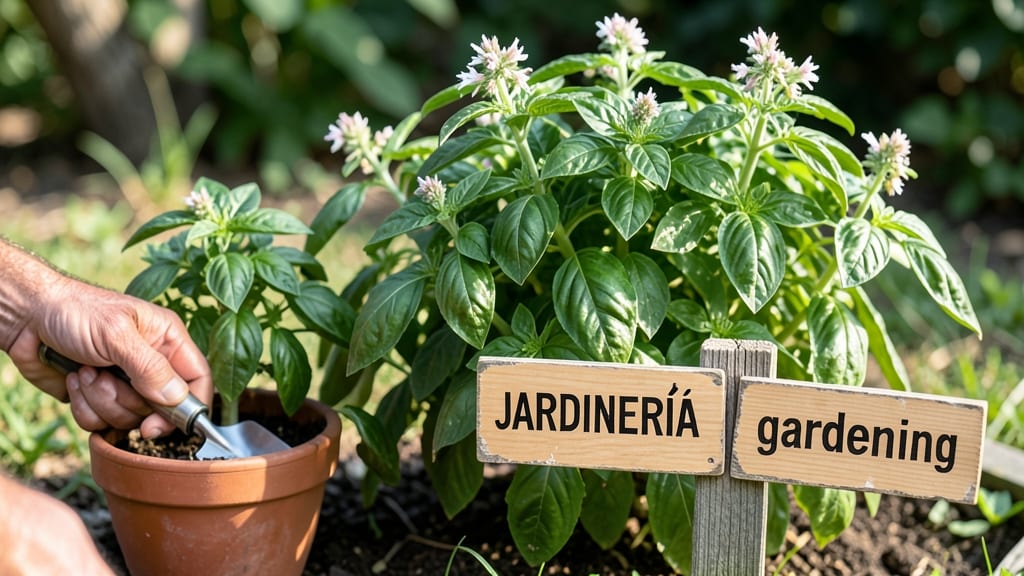
To say 'gardening' in Spanish, choose the right term based on context: jardinería for the practice itself, huerto for vegetable gardening, or jardín for ornamental plants. Everyday conversation uses phrases like cultivar plantas or trabajar en el jardín.
Spanish gardening vocabulary shifts based on what you're actually doing. Jardinería is your go-to for general gardening tasks, while huerto specifically refers to growing vegetables or herbs—perfect for gardeners who focus on edible plants. 🌱 In Latin America, you might hear huerticultura for commercial vegetable production, showing how terminology varies by region.
For ornamental plants, jardín is the standard, but in Spain, jardinería ornamental adds clarity for specialized work.
Casual conversations often use simpler phrases like cultivar plantas ("to grow plants") or trabajar en el jardín ("to work in the garden"), which are universally understood. These terms work well when chatting with neighbors or sharing tips in local gardening groups.
The key is matching your vocabulary to both the type of gardening and the cultural context—whether you're in Spain, Mexico, or Argentina.
💡 In This Article
- Spanish Gardening Vocabulary by Context and Region
- Practical Phrases for Gardeners Learning Spanish
Spanish gardening vocabulary by context and region
The Spanish language divides gardening terms sharply between Spain and Latin America, with subtle but meaningful differences. In Spain, jardinería is the broad term for gardening as a practice, while huerticultura specifically refers to commercial vegetable production—a distinction you won’t find in most Latin American dialects.
Meanwhile, in countries like Mexico or Colombia, huerto covers both home vegetable gardens and larger-scale farming plots, reflecting the region’s deep agricultural traditions.
For specialized gardening types, the vocabulary becomes even more precise. Jardinería botánica refers to botanical gardens, where plant classification and conservation take priority, while jardinería urbana describes community or rooftop gardens in cities. Organic gardening uses agricultura ecológica or jardinería orgánica, terms that emphasize sustainable practices.
The texture of these words reflects their purpose—jardinería feels broad and practical, while huerticultura carries the weight of agricultural expertise.
Regional dialects add another layer. In Andalusia (Spain), you might hear huertillo for small home vegetable patches, while in Argentina, huerta familiar describes family-run gardens. These nuances matter when discussing techniques—like acolchado (mulching) or poda (pruning)—which are universally understood but framed differently.
For example, poda de formación (training pruning) in Spain contrasts with podar para dar forma (pruning to shape) in Latin America, showing how verb phrases adapt to local gardening cultures.
Cultural context also shapes terminology. In Spain, jardinería de interior refers to indoor plants, while in Latin America, macetas de plantas (potted plants) is more common.
Even the act of regar (watering) has regional rhythms—Spaniards might say regar a mano (hand-watering), while Mexicans prefer riego por goteo (drip irrigation) for efficiency. These differences reflect climate and tradition, with Mediterranean Spain favoring drought-resistant techniques and Latin America embracing lush, water-intensive gardens.
For gardeners working with succulents or cacti, jardinería de suculentas is the go-to term in Spain, while cactus y suculentas dominates in Latin America. The sensory experience differs too—Spanish gardens often emphasize aromas (like rosemary or lavender), while Latin American gardens prioritize colors (bright flowers, citrus trees).
This contrast mirrors how gardening is perceived: as an art form in Spain or a practical necessity in many Latin American cultures.
Understanding these regional terms helps you connect with local gardening communities. For instance, in Peru, huerta andina refers to high-altitude gardens, while in Spain, jardín mediterráneo highlights drought-resistant landscaping.
The key is listening to how locals describe their work—whether they say \"cultivo tomates\" (I grow tomatoes) or \"tengo un huerto\" (I have a garden plot). These phrases reveal not just vocabulary but the soul of the practice.