
Tools
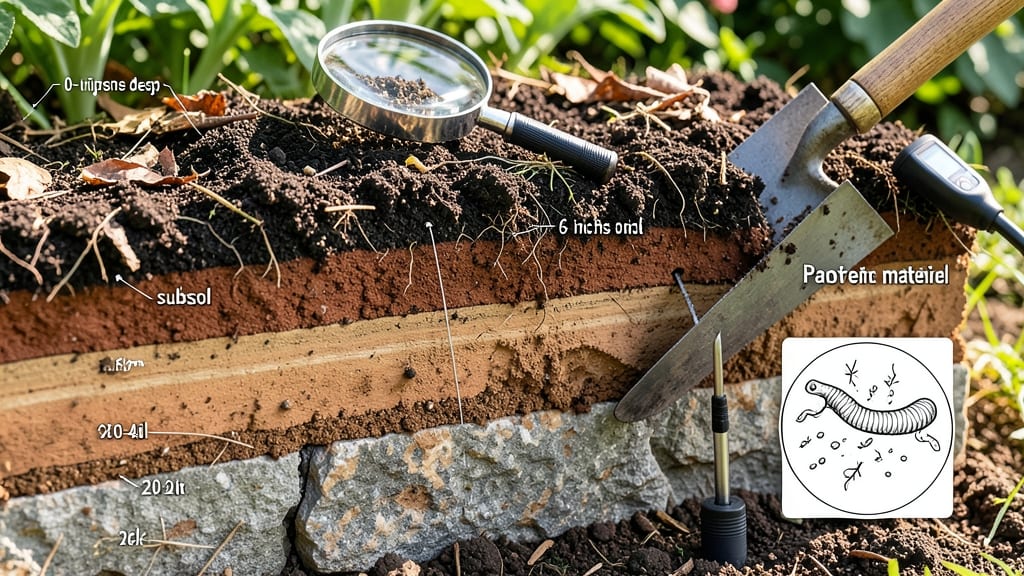
Understanding garden soil layers helps you identify the distinct horizons (O, A, B, C, R) that determine plant health, water drainage, and nutrient distribution in your yard.
Each soil horizon forms through natural processes like organic decay, mineral leaching, and biological activity.
The topmost layer (O) is rich in decomposed plant matter, while the A horizon—true topsoil—holds most nutrients for roots. 🌱 Below that, the B layer accumulates minerals from above, and the C layer consists of broken parent rock. The R layer is unweathered bedrock.
Knowing these layers helps you amend compacted subsoil or enrich topsoil for stronger plant growth.
To examine your soil's horizons, dig a small trench and observe color/texture changes. Dark, crumbly topsoil contrasts with denser subsoil. Tools like a soil auger or trowel make this easier, while a simple pH test can reveal nutrient imbalances across layers.
Amending with compost or sand can improve drainage in compacted zones.
💡 In This Article
- Understanding Soil Horizon Composition
- Practical Ways to Test and Improve Soil Layers
Understanding soil horizon composition
The uppermost layer, called the O horizon, is where decomposition reigns supreme.
This layer consists primarily of organic matter like fallen leaves, twigs, and partially decomposed plant material. 🌿 Think of it as nature's composting bin—microorganisms, fungi, and insects break down this material into humus, a dark, spongy substance rich in nutrients.
The O horizon typically ranges from 1-10 inches deep, depending on climate and plant activity, and feels lightweight and crumbly when dry.
Beneath the O horizon lies the A horizon, or true topsoil, where most plant roots thrive. This layer is a mix of mineral particles, organic matter, and living organisms like earthworms and bacteria.
The A horizon usually spans 5-10 inches deep and appears darker than deeper layers due to its higher organic content. Its texture is often granular or crumbly, allowing for good water retention and aeration.
This is where nutrients like nitrogen, phosphorus, and potassium accumulate, making it the most fertile layer for plant growth.
The B horizon, or subsoil, is where minerals from above accumulate through a process called illuviation.
Here, clay, iron, and aluminum compounds leach down from the A horizon and redeposit, giving this layer a denser, more compact feel. 🏗️ The B horizon typically ranges from 10-30 inches deep and often appears lighter in color due to the lack of organic matter.
Its texture is usually denser and more clay-heavy, which can restrict root growth if not amended properly.
Below the B horizon is the C horizon, composed of partially weathered parent material like broken rock fragments and mineral deposits. This layer lacks organic content and serves as a transition zone between soil and bedrock. The C horizon can extend 3-10 feet deep and often feels coarse and gritty.
Finally, the R horizon is unweathered bedrock, which forms the foundation of the soil profile and remains largely unchanged by biological or chemical processes.
Each horizon plays a critical role in supporting plant life. For example, the O and A horizons provide essential nutrients, while the B horizon stores water and minerals. The C horizon acts as a water reservoir, slowly releasing moisture to deeper roots.
Understanding these layers helps gardeners make informed decisions about soil amendments, irrigation, and plant selection based on root depth and nutrient needs.