
Tools
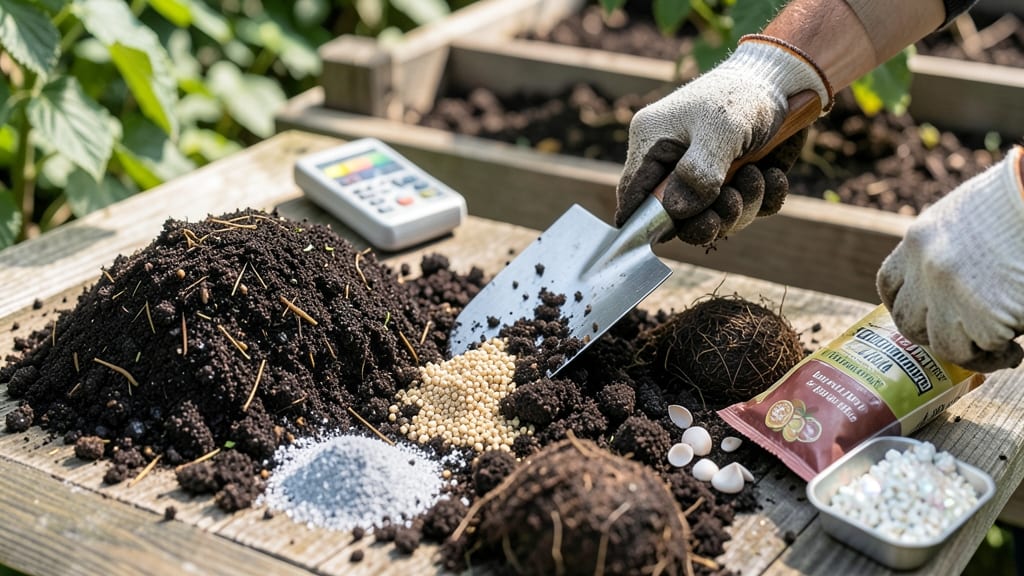
When you want to know what to mix into garden soil, blend organic compost, aged manure, and perlite to enhance drainage, nutrient availability, and root development while maintaining balanced soil pH for optimal plant health.
These three amendments work together to create the perfect growing medium. Organic compost introduces beneficial microbes and decomposes to release nutrients gradually, while aged manure provides a slow-release nitrogen boost that feeds plants over months.
Perlite, a lightweight volcanic rock, prevents compaction and improves aeration, which is especially critical in heavy clay soils. 🌱 Together, they create a well-structured environment where roots can thrive and plants access water and nutrients more efficiently.
For best results, I recommend adjusting ratios based on your soil type. Sandy soils benefit from more organic matter to retain moisture, while clay-heavy soils need additional perlite or coarse sand to improve drainage.
Always test your soil's pH first—most vegetables prefer a slightly acidic to neutral range between 6.0 and 7.0.
💡 In This Article
- How Soil Amendments Boost Plant Growth
- Best Soil Mixes for Different Climates and Plant Types
How soil amendments boost plant growth
Soil amendments work by addressing three critical factors: aeration, nutrient availability, and water retention. Organic compost, for example, introduces beneficial microbes that break down organic matter into plant-accessible nutrients. These microbes also produce enzymes that help dissolve minerals in the soil, making them available to roots.
A single tablespoon of well-aged compost can contain billions of microbes, which actively decompose plant residues and release nutrients like nitrogen, phosphorus, and potassium over time.
The texture of amendments plays a crucial role too. Perlite, with its porous structure, increases soil aeration by preventing compaction—roots need oxygen as much as water and nutrients. In heavy clay soils, adding 20-30% perlite by volume can improve drainage by up to 40% while maintaining moisture for plant roots.
Meanwhile, aged manure acts as a slow-release fertilizer, providing a steady supply of nitrogen that supports leafy growth without the risk of burning plants that comes with synthetic fertilizers.
What most gardeners don't realize is how these amendments interact with soil pH. Organic matter from compost helps buffer acidic soils, gradually raising pH toward the ideal 6.0-7.0 range for most vegetables. This buffering effect occurs because decomposing organic material produces alkaline byproducts.
For example, composted leaves or grass clippings can raise soil pH by 0.5-1.0 points over a growing season, creating an optimal environment for nutrient uptake.
Consider how these components work together in a raised bed. A mix of 50% native soil, 30% compost, and 20% perlite creates a loose, crumbly texture that roots can easily penetrate. The compost provides immediate food for microbes while the perlite maintains air pockets for oxygen exchange.
This combination supports faster germination and stronger root development compared to unamended soil, where roots often struggle to grow deeper than 6 inches due to compaction.
The science behind these benefits comes from soil physics. Well-amended soil has a structure called "aggregates"—clumps of particles bound together by organic matter and microbial activity. These aggregates create tiny pores that hold water and air, allowing roots to access both simultaneously.
In contrast, compacted soil has fewer pores, forcing roots to compete for oxygen and water. Adding 1-2 inches of compost annually can maintain this ideal aggregate structure over time.
For container gardens, the principles are similar but require more precise ratios. A mix of 60% potting soil, 20% compost, and 20% perlite works well for herbs and vegetables, while adding 10% worm castings boosts microbial activity.
The key is maintaining this balance—too much perlite can drain nutrients away, while too much compost can create anaerobic pockets that suffocate roots.
What makes these amendments especially powerful is their synergy. The microbes in compost break down manure, while the perlite prevents compaction that would otherwise limit root growth. This teamwork creates a self-sustaining ecosystem where plants can thrive with minimal intervention. 🌱