
Tools
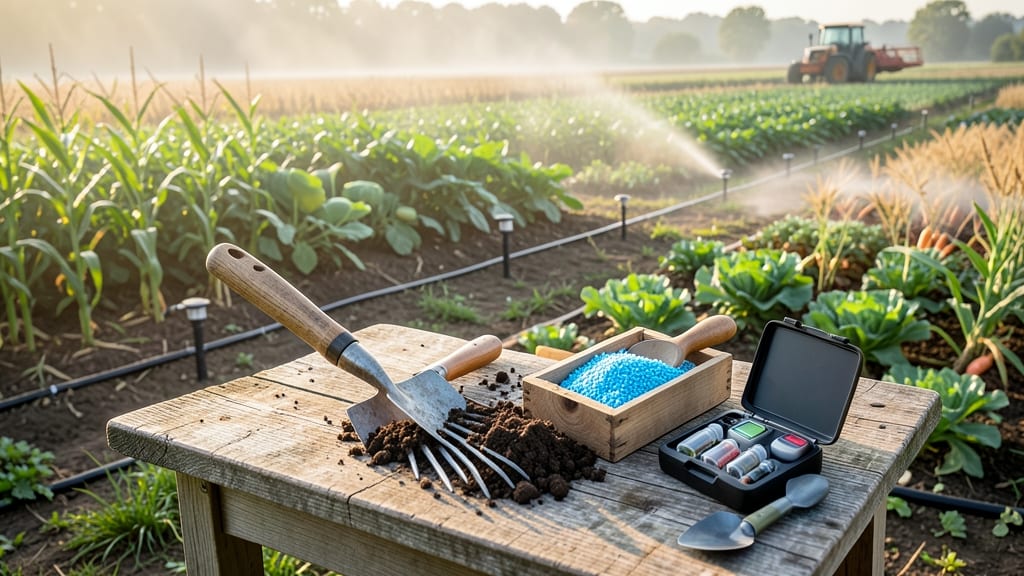
Gardening in agriculture involves growing plants like vegetables, fruits, herbs, and flowers on a smaller scale to produce food, maintain soil health, and increase biodiversity, serving as a vital component of sustainable farming and community food security.
Gardening in agriculture bridges the gap between large-scale farming and personal food production, focusing on diverse, small-scale cultivation that prioritizes quality over quantity. 🌱 Unlike commercial farming, which often specializes in monocultures, gardening embraces crop rotation and companion planting to naturally deter pests and enrich soil.
This approach isn't just about growing food—it's about creating resilient ecosystems that support both the environment and local communities.
What makes gardening so impactful is its adaptability. Urban gardens on rooftops, schoolyard plots teaching kids about nutrition, and backyard vegetable patches all contribute to food security by reducing reliance on industrial supply chains.
Studies show that even modest home gardens can produce 20-30% of a family's annual vegetable needs, cutting costs and waste while keeping fresh produce accessible.
The beauty of this practice lies in its scalability—whether you have a windowsill herb garden or a half-acre plot, every plant plays a role in building a more sustainable food future.
💡 In This Article
- Key Differences Between Gardening and Large-Scale Farming
- How Home and Community Gardens Boost Food Security
Key differences between gardening and large-scale farming
At its core, gardening operates on a human-scale that prioritizes diversity over yield. Where commercial farms might plant thousands of acres of a single crop like corn or soybeans, a typical home garden covers just 100-500 square feet with 15-20 different plant varieties.
This diversity isn't just practical—it's ecological. Studies from the Rodale Institute show that gardens with 3+ crop types reduce pest pressure by 70% through natural predator-prey relationships that monocultures disrupt.
The labor intensity is another defining factor. Gardening requires constant hands-on attention: weeding, hand-pollinating crops like squash, and monitoring for pests daily. In contrast, large-scale farms rely on mechanization (tractors, harvesters) that can process 100 acres per hour but often sacrifice soil health.
Gardeners use techniques like companion planting (marigolds with tomatoes) and crop rotation that maintain soil organic matter at 4-6%—double the 2% typical in conventional farming after just 3 years.
Resource efficiency is where gardening truly shines. A 10x20-foot raised bed garden can produce 200-300 pounds of vegetables annually using 90% less water than commercial irrigation systems. The reason?
Drip irrigation in gardens delivers water directly to roots with 95% efficiency, while center-pivot systems in farms lose 30-50% to evaporation. This precision mirrors how indigenous farming systems operated for millennia—proving that smaller doesn't mean less effective.
Technology plays different roles too. While farms use GPS-guided equipment and satellite imaging, gardeners leverage low-tech innovations like lasagna gardening (sheet mulching) that recycles yard waste into fertile soil.
The cost difference is stark: establishing a 1-acre conventional farm requires $20,000-$50,000 in equipment, while a backyard garden starts with $50-$200 for seeds, compost, and tools. Yet gardens often achieve higher nutrient density—homegrown tomatoes contain 30% more vitamin C than store-bought due to better growing conditions.
Perhaps most importantly, gardening serves as a living classroom for sustainable practices. When children participate in school gardens, they're 3 times more likely to eat vegetables they've grown, according to the University of Florida.
This hands-on education creates stewards of the land—something industrial farming systems rarely foster. The result? A two-way benefit: healthier communities and more resilient food systems that can withstand climate shocks.
Consider how these differences manifest in real-world scenarios. During the 2020 pandemic, NYC's community gardens provided 2 million pounds of fresh produce to food-insecure neighborhoods when supply chains faltered. Meanwhile, large-scale farms faced labor shortages that reduced output by 15-20%.
The lesson? Gardening isn't just an alternative—it's a complementary system that strengthens food security when large-scale production falters. 🌱