
Size
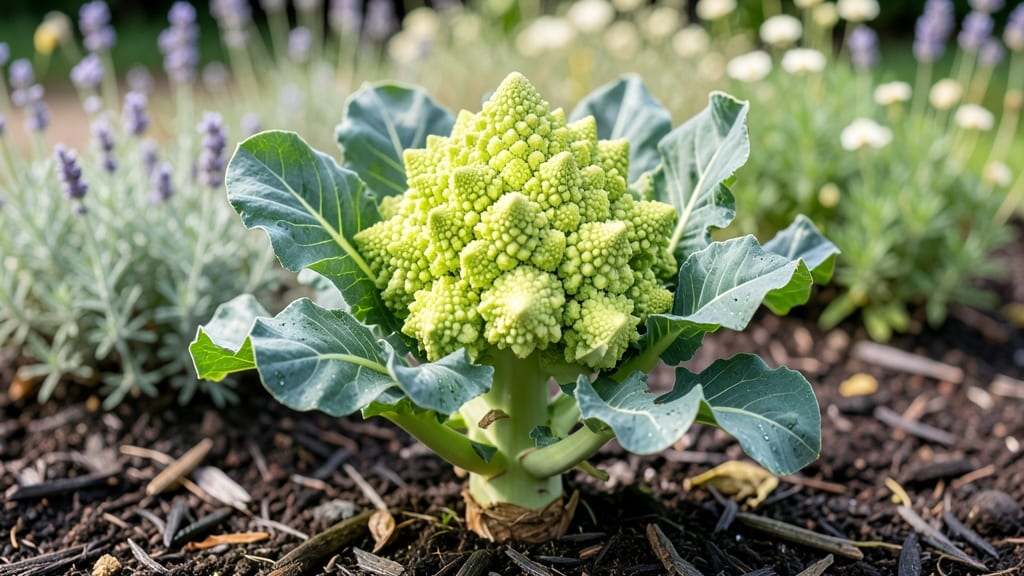
Romanesco does not grow back in a garden after harvest because it is an annual plant with a single harvest cycle, though its edible buds form on a sturdy stem that may regrow slightly if conditions are ideal. Proper care can extend its lifespan marginally, but replanting is required for future yields.
Romanesco's annual nature means its entire energy focuses on producing that one stunning fractal head before dying back. 🌱 Unlike perennials that regrow from roots, romanesco's main stem completes its growth cycle within 100-120 days, making it a one-time harvest plant.
However, you can maximize your yield by saving seeds from mature plants for next season's garden—this way, you're essentially "growing back" romanesco through new seedlings rather than relying on the same plant to regenerate.
For gardeners hoping to coax extra growth, focus on maintaining optimal conditions—consistent moisture, well-draining soil rich in organic matter, and full sun exposure. These factors help the plant reach its full potential before harvest, but even with perfect care, the original plant won't produce another head after cutting.
The good news is that romanesco's seeds remain viable for several years when stored properly, giving you multiple opportunities to enjoy this unique vegetable in future growing seasons.
💡 In This Article
- Romanesco Plant Lifespan and Growth Cycle Explained
- Maximizing Romanesco Yield Before Harvest
Romanesco plant lifespan and growth cycle explained
Romanesco belongs to the brassica family, like broccoli and cauliflower, but its growth cycle is fundamentally different. As an annual plant, it completes its entire life cycle—from seed to harvest—in just 100-120 days under ideal conditions.
The plant's energy is entirely focused on producing that single, iconic fractal head, which forms through a process called determinate growth. Unlike perennial vegetables that regrow from roots, romanesco's stem matures and dies back after harvest, leaving no viable structure for regeneration.
The fractal pattern emerges from a complex interplay of genetics and environmental factors. Each bud contains 137° angles (a golden ratio), creating the geometric marvel we recognize. This growth happens on a single, sturdy stem that develops from the seedling stage.
The plant allocates nearly all its resources to this primary head, leaving little energy for secondary growth. Even if you leave the stem intact after harvest, the plant's biological clock has already triggered senescence—the natural aging process that ends its productive life.
What makes this especially interesting is how the plant's growth mirrors mathematical precision. The buds form in a logarithmic spiral, where each new bud grows at a 1.618 ratio (the golden ratio) to the previous one.
This isn't just aesthetic—it's an evolutionary adaptation that maximizes exposure to sunlight while conserving energy. Unlike indeterminate plants (like tomatoes) that continue producing, romanesco's growth is a one-time event designed for efficiency rather than longevity.
For gardeners hoping to see any regrowth, the key lies in the plant's stem.
While the main head won't return, the stem itself might produce 2-3 smaller side shoots if conditions remain optimal—think full sun (6-8 hours daily), consistent moisture (1-1.5 inches per week), and nutrient-rich soil (pH 6.0-7.0).
These side shoots will never match the primary head's size or complexity, but they can provide a few more edible buds before the plant finally dies back completely.
The real secret to "growing back" romanesco lies in saving seeds. After the plant bolts (sends up its flowering stalk), it produces seed pods that remain viable for 2-4 years when stored in a cool, dry place.
This gives you the opportunity to replant and enjoy another full cycle of fractal beauty. The process mimics how wild brassicas propagate, ensuring you can continue harvesting this botanical wonder year after year—just not from the same plant.
Understanding this growth cycle helps explain why romanesco feels so special. Its entire life is compressed into that single harvest window, making each plant a temporary but spectacular event in your garden.
The trade-off is what gives romanesco its unique charm—you're not getting multiple harvests, but when it's ready, you get that one perfect, mathematically precise head that's unlike anything else in the garden. 💫