
Light Requirements
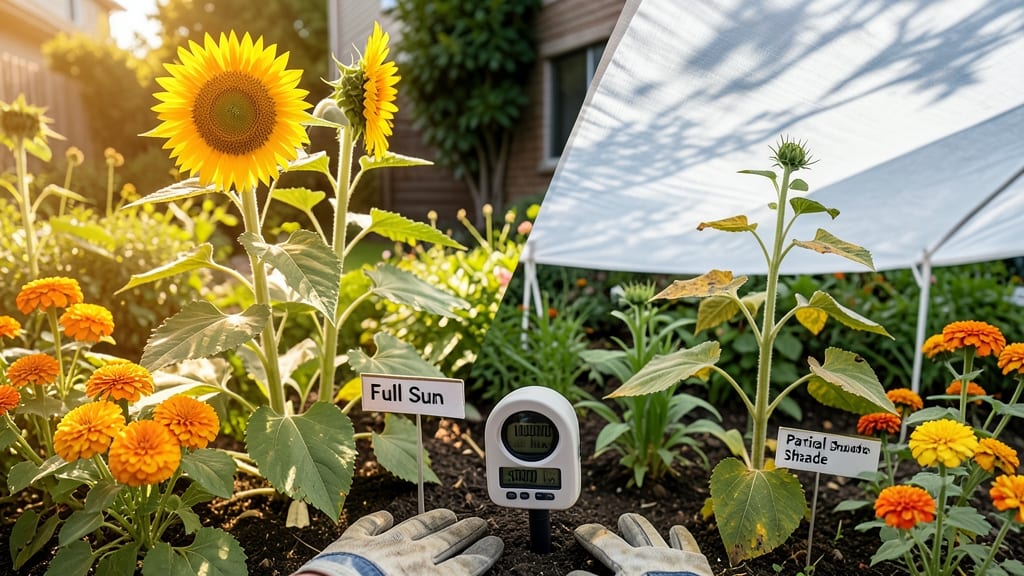
Not all gardens need full sun—light needs depend on the plants you grow, with many thriving in partial shade (4-6 hours of sunlight) or even low light (under 4 hours). While sun-lovers like tomatoes and peppers require 6+ hours of direct light, leafy greens and herbs often grow better with less. Match your garden layout to your plants' specific sunlight preferences.
Sunlight isn't a one-size-fits-all requirement—it's more about understanding each plant's unique needs. 🌱 For example, leafy greens such as spinach and kale actually prefer partial shade to prevent bolting (premature flowering), while flowering plants like impatiens and begonias thrive in dappled sunlight.
The key is observing how your plants respond: yellowing leaves often signal too much light, while leggy growth indicates they need more. I always recommend starting with shade-tolerant varieties if your garden gets limited sunlight—hostas and ferns are perfect for those tricky spots.
Even in shadier areas, you can create a productive garden by choosing the right plants and optimizing their growing conditions. Amending soil with compost improves nutrient uptake, and mulching helps retain moisture—critical factors for plants growing in less-than-ideal light.
The beauty of gardening is its flexibility: with the right plant selection, you can turn even the shadiest corner into a thriving green space.
💡 In This Article
- How Sunlight Affects Plant Growth and Health
- Best Low-Light and Partial-Shade Plants for Gardens
How sunlight affects plant growth and health
Sunlight drives photosynthesis—the process where plants convert light energy into chemical energy to fuel growth. Chlorophyll, the green pigment in leaves, absorbs light most efficiently in the blue (400-500nm) and red (600-700nm) wavelengths, which is why full-sun plants develop deeper green foliage.
However, too much direct light can actually damage cells by generating excess reactive oxygen species, leading to leaf scorch—a common issue in heat-stressed plants like basil. 🌿
Light intensity also triggers hormonal responses that determine plant structure. For example, 6+ hours of full sun promotes robust flowering in tomatoes by stimulating ethylene production, while 4-6 hours encourages leafy growth in lettuce.
Shade-loving plants, like hostas, produce more chlorophyll in their leaves to compensate for lower light levels, creating that rich, deep green color. The trade-off? They grow slower because photosynthesis operates at reduced capacity, requiring more efficient nutrient cycling.
Disease resistance is another critical factor influenced by light exposure. Plants growing in low light often develop weaker cell walls, making them more susceptible to fungal infections like powdery mildew. This is why shade-loving plants need excellent air circulation and may benefit from fungicidal sprays.
In contrast, full-sun plants like peppers develop thicker cuticles that repel pests naturally. The key is matching light levels to a plant's evolutionary adaptations—what thrives in a forest understory won't survive in a desert garden.
Even within a single species, light requirements can vary by variety. For instance, some lettuce cultivars are bred to tolerate full sun (like 'Black Seeded Simpson'), while others bolt quickly in anything beyond 4 hours of light.
This genetic diversity means gardeners can often find alternatives to their favorite plants that suit their light conditions. The trick is checking seed packets or plant tags for specific light recommendations—these often include terms like "partial shade" (meaning 3-6 hours) or "deep shade" (under 3 hours).
Temperature plays a hidden role too. In hot climates, plants receiving full sun may need afternoon shade to prevent heat stress, while in cooler regions, they might thrive in direct light year-round.
This is why microclimates matter—your garden's orientation, nearby buildings, and even soil color (dark soil absorbs more heat) can alter effective light exposure by 20-30%. Always observe your garden's specific conditions before making assumptions about sunlight availability.
One fascinating adaptation is how some plants change their growth patterns based on light quality. For example, phototropism causes stems to grow toward light sources, while shade avoidance responses make plants stretch rapidly when competing for light in crowded conditions.
This is why leggy seedlings often appear in low-light situations—they're desperately trying to reach more photons. Understanding these mechanisms helps gardeners create optimal growing conditions without overcomplicating setups.