
Light Requirements
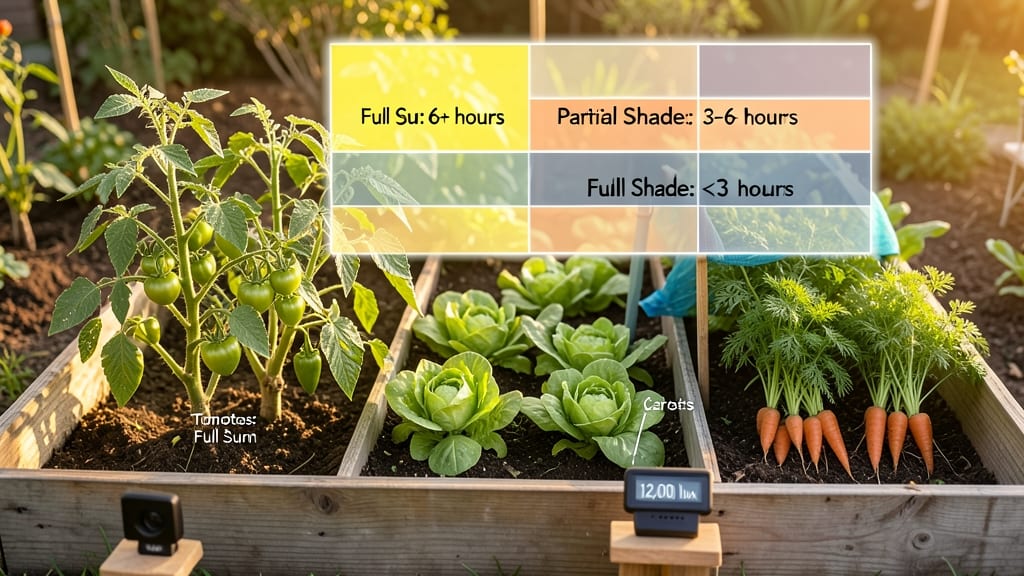
A vegetable garden needs 6 to 8 hours of sunlight daily for most crops to thrive, but guessing wrong can mean the difference between a bountiful harvest and wasted effort.
Struggling to grow thriving vegetables? Sunlight is the #1 factor determining your garden’s success—or failure—yet most gardeners guess wrong on how much their plants truly need.
Too little sun and your tomatoes won’t set fruit, while too much can scorch leafy greens. The key is matching each crop’s needs—whether it’s full sun for peppers or partial shade for lettuce—to your garden’s natural light.
Below, I break down the exact sunlight hours for 20+ common vegetables, plus tips to optimize placement and troubleshoot common issues like bolting or stunted growth.

Sunlight requirements by vegetable type: full sun vs partial shade explained
Understanding how much sunlight your vegetables need is the foundation of a thriving garden. Full sun (6+ hours of direct sunlight) fuels high-yield crops like tomatoes and peppers, while partial shade (2-4 hours) suits leafy greens.
Even small differences in sunlight exposure can mean the difference between a bumper crop and disappointing harvests. Let’s break down the exact sunlight needs for your favorite vegetables so you can place them perfectly in your garden.
Most gardeners assume all vegetables need full sun, but that’s not true. Root crops like carrots and beets actually prefer partial shade to prevent bolting, while fruiting plants like cucumbers and eggplants demand maximum sunlight.
Even within the same family, varieties can differ—like cherry tomatoes needing more sun than heirloom tomatoes. Knowing these distinctions helps you optimize your garden layout for peak productivity.
Here’s the key rule: Fruiting vegetables (tomatoes, peppers, squash) need 6+ hours of sun, leafy greens thrive with 4-6 hours, and root crops do best in 2-4 hours.
Below, I’ve organized the most common vegetables by their sunlight needs, so you can quickly identify where each belongs in your garden.
| Vegetable | Sunlight Needs | Ideal Hours/Day | Notes |
|---|---|---|---|
| Tomatoes | Full Sun | 6-8+ | Dwarf varieties tolerate 6 hours; indeterminate types need 8+ |
| Peppers (Bell, Jalapeño) | Full Sun | 6-8+ | Minimum 6 hours; more sun = sweeter fruit |
| Cucumbers | Full Sun | 6-8+ | Vining types need trellis support in full sun |
| Squash (Zucchini, Butternut) | Full Sun | 6-8+ | Large leaves need space; mulch to retain moisture |
| Eggplants | Full Sun | 6-8+ | Heat-loving; avoid partial shade in hot climates |
| Lettuce (Leaf Types) | Partial Shade | 2-4 | Bolts in full sun; harvest outer leaves |
| Spinach | Partial Shade | 2-4 | Tolerates 4-6 hours in cooler climates |
| Kale | Partial Shade | 3-6 | Sweeter after frost; avoid extreme heat |
| Carrots | Partial Shade | 2-4 | Prevents bolting; loosen soil before planting |
| Beets | Partial Shade | 3-5 | Harvest young for tender greens |
| Green Onions | Partial Shade | 2-4 | Regrows after cutting; great for containers |
| Basil | Full Sun to Partial Shade | 4-6 | Avoid afternoon sun in hot climates |
How to measure and adjust sunlight in your garden for optimal growthGetting your garden’s sunlight right is like finding the perfect recipe—too much or too little, and your vegetables won’t thrive. Many gardeners assume their space gets full sun when it’s actually partial shade, or vice versa. I’ve learned the hard way that even a 2-hour difference in sunlight can mean the difference between a bumper crop and bolting lettuce. Let’s fix that with practical steps to measure and optimize your garden’s light. Start by observing your garden’s sunlight patterns over a week. Use a sunlight journal or app like SunCalc to track how shadows shift. Most vegetable gardens need 6-8 hours of direct sun, but some areas might only get 4 hours or less. I once planted tomatoes in what I thought was full sun—only to realize they were getting just 5 hours due to a nearby tree. Adjusting their placement saved my harvest!
If your garden has hot afternoons, consider using shade cloth to protect delicate plants like lettuce or spinach. I use a 30% shade cloth in summer to prevent my greens from wilting. For container gardens, rotate pots weekly to ensure even sunlight exposure—this helps prevent lopsided growth in plants like tomatoes or peppers. Don’t forget to account for seasonal changes! A spot that gets full sun in summer might only receive partial shade in winter due to lower sun angles. I adjust my planting schedule based on this—planting winter squash in early summer when the sun is strongest, then moving cool-season crops like kale into the same spot as days shorten. Finally, monitor your plants’ health as your garden’s sunlight guide. Yellowing leaves? Too much sun. Leggy stems? Not enough. I keep a plant health checklist to track these signs and adjust accordingly. With these steps, you’ll turn your garden into a sunlight-optimized powerhouse—no more guesswork, just thriving veggies! 🌱 |