
Tools
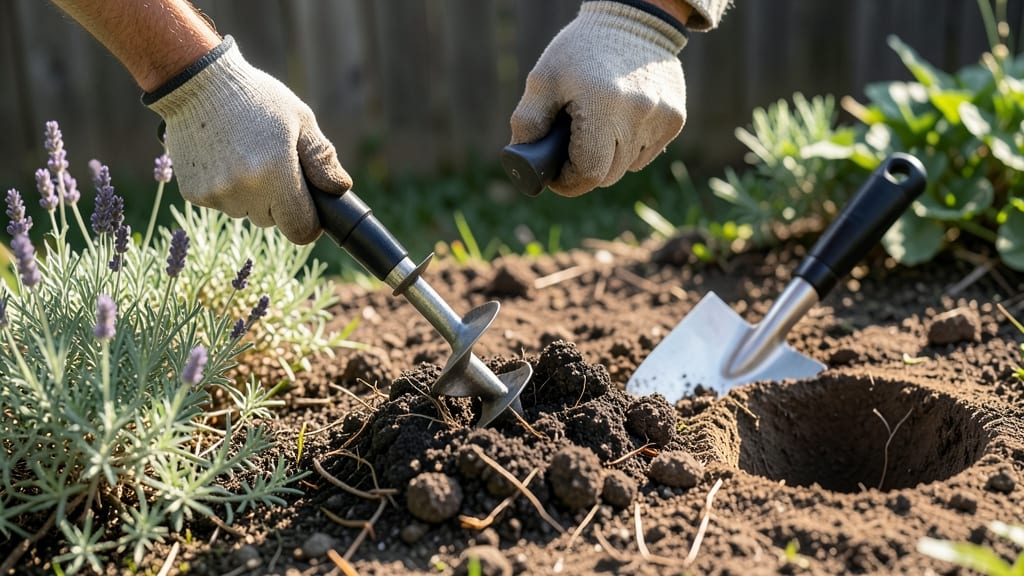
A garden auger makes planting easier by creating precise holes with minimal effort, and you'll need to pick the right size for your plants, brace the tool firmly, and twist it steadily while applying downward pressure. Always remove debris and verify depth before planting.
A garden auger transforms tough planting tasks into quick work, especially when dealing with compacted soil or large plants.
The spiral blades cut through dirt efficiently, saving you hours of digging by hand. 🔥 For beginners, I recommend starting with a 12-inch manual auger—it's versatile enough for most garden projects while being lightweight.
The key is maintaining steady pressure while twisting, which prevents the tool from getting stuck mid-hole. Pro tip: Always measure your hole depth against your plant's root ball to ensure proper spacing for healthy growth.
This tool shines when planting trees, shrubs, or deep-rooted perennials where manual digging would be impractical. The right auger size prevents soil compaction around roots, giving plants the space they need to establish themselves.
For rocky soil, consider an electric auger with variable speed settings—it handles tough conditions better than manual models. Just remember: the deeper the hole, the more stable your plant will be against wind and drought.
💡 In This Article
- How a Garden Auger Works: Mechanics and Soil Types
- Best Garden Auger Types for Different Planting Needs
How a garden auger works: mechanics and soil types
A garden auger's spiral blades function like a corkscrew, cutting through soil while simultaneously pulling it upward and outward. The twisting motion creates a clean, cylindrical hole while displacing dirt through the auger's hollow shaft.
This mechanism is particularly effective because the blades' sharp edges shear through soil particles rather than pushing them aside, which is why augers work so well in compacted clay where shovels struggle.
The deeper you go, the more the soil's natural resistance increases—this is why most augers have 12- to 24-inch depth limits for manual models.
The soil type dramatically affects how easily an auger works. In sandy soil, the blades glide through with minimal resistance, making it ideal for quick planting.
However, in clay-heavy soil, the blades must exert more force, which is why electric augers often include variable speed settings to prevent overheating. The spiral design also helps prevent soil from clogging the blades during extraction—a common frustration with poorly designed augers.
For example, a 6-inch diameter auger can handle most shrubs, while a 12-inch diameter is better suited for trees with larger root balls.
Depth control is critical because it directly impacts root development. Plant roots need space to spread horizontally before growing downward, which is why holes should be 2-3 times wider than the root ball and 1.5 times deeper.
For instance, a 3-foot-deep hole for a small tree allows roots to establish themselves before the plant needs to seek deeper moisture. The auger's depth markings (usually in inches) help you gauge this precisely.
If you overshoot, you risk creating a hole that fills with water during rain, suffocating the roots. Conversely, too shallow a hole forces roots to grow upward, making the plant more vulnerable to drought.
Soil moisture also plays a role in auger performance. Dry, powdery soil crumbles easily, while wet soil sticks to the blades, increasing friction.
This is why many gardeners prefer to work in moderately moist conditions—the soil holds together enough to be displaced but isn't so wet that it clogs the auger. For stubborn cases, a few drops of soapy water on the blades can reduce friction, though this is a last resort.
The auger's efficiency also depends on blade sharpness; dull blades require more force, increasing the risk of slipping or injury. Sharpening the edges annually can extend the tool's lifespan and improve performance.
One often-overlooked factor is the auger's pitch—the distance between each spiral turn. A tighter pitch (closer spirals) works better in loose soil, while a wider pitch handles denser materials.
For example, a 1-inch pitch auger excels in garden beds, whereas a 1.5-inch pitch is better for breaking through compacted subsoil. Understanding these mechanics helps you choose the right tool for your soil type, ensuring smoother planting and less physical strain.
The right auger doesn't just save time—it sets the foundation for healthier plants.
For beginners, I recommend practicing on a small patch of soil first to get a feel for the tool's resistance and how much pressure to apply. The key is to let the auger do the work—don't force it.
If you encounter resistance, stop and check for rocks or roots that might be binding the blades. A garden auger is designed to make planting effortless, not turn it into a workout. 🌱